Marine conservation, female solidarity and sustainable solutions for Haiti

How did you go from the unstable context of Haiti to French research laboratories?
My career began at the Haitian Ministry of the Environment, where I was confronted with the ecological challenges of a country in need of development. I obtained a PhD through an international joint supervision programme between Nantes University (France) and Quisqueya University (Haiti). Scientific mobility, obtained through the FMSH's ‘Thémis’ programme, offered me a haven of peace, far from a national context marked by significant political and logistical constraints. For three months, I delved deeper into a sub-theme of my doctoral thesis on ‘The race for Marine Protected Areas (MPAs) in the Caribbean: Focus on management and governance issues in Haiti, Cuba and Guadeloupe’ in a working environment conducive to creativity and concentration. Welcomed into the LETG (Coastal Areas, Environment, Remote Sensing, Geomatics) laboratory in Nantes, I conducted fascinating research on gender and marine conservation under the supervision of Professor Michel Desse. This research is a continuation of my thesis, which highlighted the cosmetic instrumentalisation of women in the implementation of MPAs in Haiti. Far from being a mere academic interlude, this immersion in France rekindled my strong commitment to the Caribbean islands. Today, I am more convinced than ever that research should serve to amplify the voices of invisible social groups. In Haiti, it should enable the co-construction of promising solutions with the silent victims of chronic instability.

Haïti

Haïti

Haïti

What were the main results of your research during your mobility at the LETG laboratory at Nantes University?
Initially, the FMSH grant was intended to help me develop a critical research topic: ‘The “sorority of female traders” in the fishing industry facing the economic crisis in Haiti’. The topic was also selected for publication in the collective work Le Monde en crise(s), edited by Claire Decobert and Rodolphe Pauvert.
Under the supervision of Professor Desse, I was able to shed light on a little-documented reality: Haitian supra-insularity. This concept provides a better understanding of how a centuries-old network of female solidarity helps to bridge the territorial divide between Port-au-Prince and adjacent islands such as Île-à-Vache thanks to the Madan Sara.
Their contributions to the fishing industry have been categorised into operational, logistical and post-harvest activities (see fig. 1). For more than two centuries, these Haitian women traders, organised in rural and urban networks, have been transporting fish products nationwide. They run a self-organised, 100% female economy that continues to supply the metropolitan area of Port-au-Prince, which is under siege, despite the collapse of the state, the marginalisation of the formal banking system and the omnipresent climate of violence.

Figure 1
The research findings, enriched by the citizen consultation An nou trase yon nouvo chimen pou Ayiti conducted by Quisqueya University and interviews in the field, highlighted two priorities for action around this sisterhood: decentralisation to restore administrative and economic autonomy to communities in the south that are stifled by the hyper-centralisation of Port-au-Prince, and official recognition of their commercial activities in order to better address material concerns in a low-income economy driven by women. While the country is torn between illegal armed groups and a transitional council of nine presidents, these women traders continue to feed entire regions... Resilient, indispensable and discreet, they embody a form of globalisation of the poor made in Haiti.
How did this fish drying system for women on Île-à-Vache in Haiti come to be during your research stay in France?
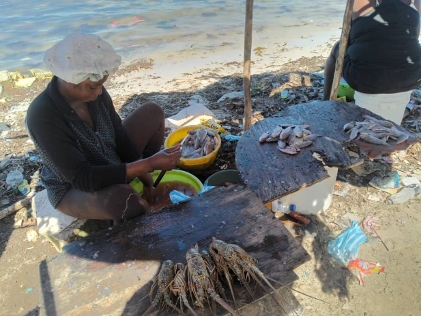
The design of the device is the result of the unexpected convergence of two complementary initiatives led by different institutions. On one hand, the Haitian Association for Women, Science and Technology (AHFST) at Quisqueya University won a call for projects in 2023 to empower women for the recovery of southern Haiti. This UN Women project, funded by the Norwegian government, includes the manufacture of raised dryers to improve the conditions for processing fish products by rural women traders. On the other hand, the FMSH supported my research on the sisterhood of women traders in the fishing industry in Haiti through a mobility programme in France. The synergy between these two projects came about naturally when the AHFST sought my expertise as an engineer-architect for the technical design of the dryers. The site where the UN Women project is being carried out coincides with the fieldwork conducted as part of the Thémis programme in 2025. During interviews conducted on Île-à-Vache, the women traders targeted by AHFST explained the difficulties associated with traditional drying methods: back pain due to the repetitive movements required to turn the fish, racing against the rain to preserve their goods, and insect infestation of the products due to excess humidity.

Pratiques de transformation artisanale de la sororité des commerçantes de la filière pêche
à l’Île-à-Vache (Salomon, 2025)

Pratiques de transformation artisanale de la sororité des commerçantes de la filière pêche
à l’Île-à-Vache (Salomon, 2025)

Pratiques de transformation artisanale de la sororité des commerçantes de la filière pêche
à l’Île-à-Vache (Salomon, 2025)

Pratiques de transformation artisanale de la sororité des commerçantes de la filière pêche
à l’Île-à-Vache (Salomon, 2025)
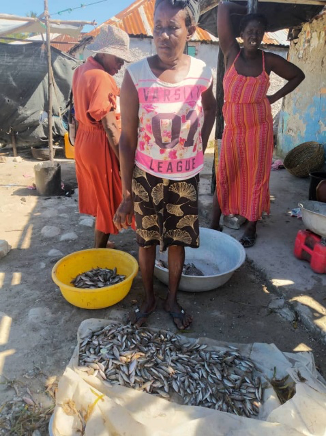
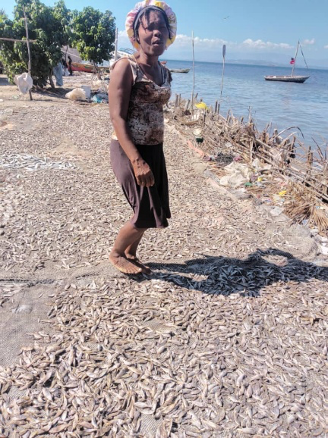
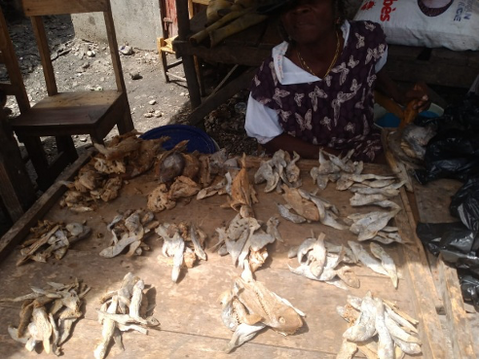
Armed with this knowledge of the constraints and in response to the mandate entrusted to them, three criteria were selected for the design of the dryer, inspired by experiences in French-speaking Africa: hygiene, practicality and durability. In consultation with senior researcher Ketty Balthazard-Accou, PhD, and agronomist Jhems Salomon, a multidisciplinary team was formed. The result? A raised dryer with natural ventilation that is both practical and environmentally friendly, offering several major advantages:
- mobile: lightweight, easy for one person to move
- ultra-ergonomic: comfortable working height and compact shape that fits through doors
- durable: rainproof and fitted with an insect-proof cover for optimal hygiene
- eco-friendly: rot-proof wooden frame combined with a ventilated mesh that protects juvenile fish, SDG 14

Conception et fabrication préliminaires du séchoir surélevé avec l’aide de l’intelligence
artificielle Adobe Firefly et du Centre d’Apprentissage et de Production de Meubles de Camp-Perrin (Pierre et Salomon, 2025)

Conception et fabrication préliminaires du séchoir surélevé avec l’aide de l’intelligence
artificielle Adobe Firefly et du Centre d’Apprentissage et de Production de Meubles de Camp-Perrin (Pierre et Salomon, 2025)

Conception et fabrication préliminaires du séchoir surélevé avec l’aide de l’intelligence
artificielle Adobe Firefly et du Centre d’Apprentissage et de Production de Meubles de Camp-Perrin (Pierre et Salomon, 2025)
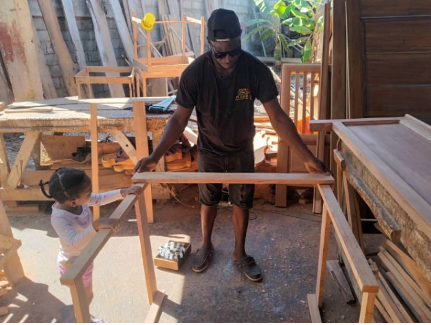
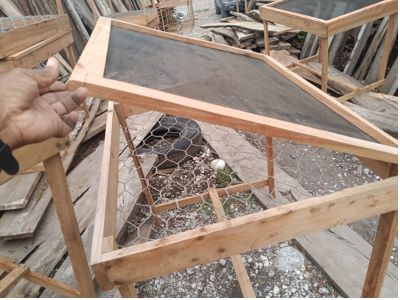
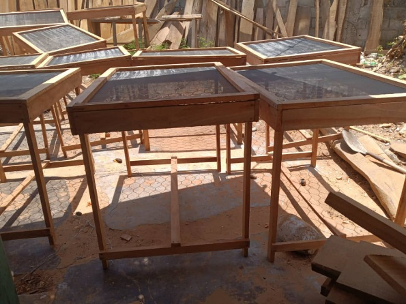
This initiative illustrates useful research... born out of listening carefully to the sisterhood of female traders on Île-à-Vache and fuelled by multidisciplinary science in the pursuit of solutions tailored to rural Haiti.
You advocate the idea of rethinking Haiti's land use planning based on its vast maritime space. Why?
My stay at the LETG at Nantes University allowed me to discover ‘marine spatial planning’, an innovative concept promoted by researchers such as Brice Trouillet. It involves rethinking the territory not only from the land but as an integrated land-sea socio-ecosystem. This approach is relevant for Haiti, whose Exclusive Economic Zone (EEZ) is 4.5 times larger than its land area. However, its EEZ is absent from public policy, even though 9 of the country's 10 departments are coastal. In addition, local populations depend on this ‘common good’ sea for their income and food... Marine protected areas help to preserve these ecosystem services. Better planning for the land from the sea means capitalising on the strategic potential of a largely undervalued area in Haiti. It also means promoting an intersectoral approach to land management in order to strengthen coastal resilience to climate and environmental hazards. This vision was advocated at the ‘Jeudi des territoires’ (Territorial Thursday) meeting of 26 June 2025 of the Interministerial Committee for Territorial Planning, organised under the auspices of the Office of the Haitian Prime Minister and coordinated by Messerne Sagesse.
Article published in the third issue of the FMSH Journal.




 Book
Book
Prêter attention. Care, science, psychanalyse

 Journal
Matières, couleurs, supports
 Book
Book
Histoire politique de l'enseignement supérieur
 Book
Book