
Maria de Fátima Morethy Couto
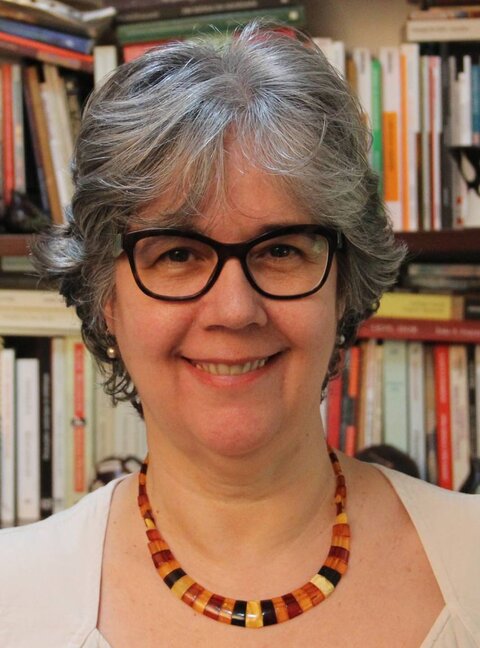

Maria de Fátima Morethy Couto holds a PhD in Art History from the University of Paris I – Panthéon-Sorbonne. She is Full Professor at the University of Campinas and has published extensively on modern and contemporary art. Her books include ABCdaire Cézanne (Flammarion, 1995); Por uma vanguarda nacional: a crítica brasileira em busca de uma identidade artística – 1940–1960 (Editora da Unicamp, 2004); and A Bienal de São Paulo e a América Latina: trânsitos e tensões (1950–1970) (Editora da Unicamp, 2023), which received the Sérgio Milliet Prize from the Brazilian Association of Art Critics (ABCA). She has also authored numerous articles on Brazilian and Latin American avant-gardes and postwar abstraction, and co-organized anthologies on these themes. She currently coordinates the FAPESP-funded project Institutional Geopolitics: Art in Dispute in Circulating Exhibitions in Brazil (1948–1978).
The project
Title: Institutional Geopolitics: art in dispute in International Traveling exhibitions in Brazil (1948-1978) - France as a case study
"My research in France is part of the project Institutional Geopolitics: Art in Dispute in Circulating Exhibitions in Brazil (1948–1978), which examines how traveling exhibitions functioned as central instruments in shaping artistic debates and cultural hierarchies in South America during the Cold War. Focusing on exhibitions that circulated across Brazil and the continent between 1948 and 1978, the project considers how initiatives originating primarily in Europe—especially France, Italy, and Britain—as well as North America, and, to a lesser extent, the Middle East, Africa, and Asia, mobilized carefully selected artists and groups to serve specific symbolic and political purposes. By mapping and analyzing this body of traveling exhibitions, the project seeks to clarify the role of cultural diplomacy and soft power in the region during the Cold War. Particular attention is given to the proactive involvement of certain nations and cultural agents, as well as to the formation of local and transnational networks and their impact on artistic production and reception in Brazil and across the continent.
Although exhibitions constitute a well-established field of study within the visual arts, relatively few studies in Brazil have explored their significance through the institutional, financial, and diplomatic relationships that shape them. By situating exhibitions at the intersection of artistic, cultural, and geopolitical interests, this research highlights the ways in which institutional dynamics inform both artistic discourse and its historical interpretation. A central premise is that traveling exhibitions must be understood as coordinated strategies for the dissemination of cultural values and the production of aesthetic experience. Their significance lies not in their apparent success, but in the competing interests they articulate—local, regional, national, and international—and in their capacity to legitimize certain artists, movements, and formal languages. This approach shifts the focus from reception alone to the conditions of possibility that govern visibility and recognition.
Building on this framework, my research focuses on exhibitions organized by Britain and France, under the auspices of the British Council and the Association française d’action artistique, that circulated in South America, particularly in Brazil. The São Paulo Biennial occupies a central place in this context, both for its regional prominence and because several national representations extended their reach beyond the event itself through subsequent circulation in museums and cultural institutions. The Biennial thus functioned as a key site of mediation and negotiation, playing a decisive role in the diffusion of artistic trends across Brazil and the broader South American context.
My stay in Paris is essential to advancing this argument, as it will allow for a more precise reconstruction of the French exhibitions presented in Brazil and South America, as well as a detailed analysis of the criteria guiding French participation in the São Paulo Biennials. By examining archival materials and institutional records, the research will analyze how these exhibitions were shaped by broader cultural policy strategies and international positioning aimed at consolidating influence within the arts and expanding their audiences. In doing so, it will clarify the role of France not merely as a cultural intermediary, but as an active agent in the geopolitical configuration of the postwar art world."
Hosting institution: Centre de recherches sur le Brésil colonial et contemporain (CRBC) - École des hautes études en sciences sociales (EHESS)
Selective Bibliography
- COUTO, M. F. M.; ALVES, M. B. (ed). Exposições e Conexões Internacionais no Museu de Arte Moderna do Rio de Janeiro. São Paulo: Intermeios, 2025.
- COUTO, M. F. M. “Entre a Bienal de São Paulo e o MAM Rio: a exposição Ben Nicholson e 10 escultores britânicos e a atuação do British Council”. In: COUTO, M. F. M.; ALVES, M. B. (ed). Exposições e Conexões Internacionais no Museu de Arte Moderna do Rio de Janeiro. São Paulo: Intermeios, 2025, v. 1, p. 131-150.
- COUTO, M. F. M. “The Pan‑American Union and the São Paulo Biennial (1955‑67) Geopolitical Arrangements in Defense of Modern Art”. In: ORZES, A.; PAJUSCO, V. & PORTINARI, S. (ed.). From Biennale to Biennials. Cartographies of an Impossible Desire. Veneza: Edizione Ca’ Foscari, 2025, v. 1, p. 45-62.
- COUTO, M. F. M. “La Bienal de São Paulo en la mira: fragmentos de una (larga) historia”. In: ZUÑIGA, J.C. F. (ed.). Bienales en América Latina y el Caribe: escenarios de confluencia de la modernidad y la contemporaneidad. San José: AICA Costa Rica, 2025, v. 1, p. 26-45.
- COUTO, M. F. M.; OLIVEIRA, E. D. & MALTA, M. (ed). Políticas da Diferença. Colaborações, cooperações e alteridades na arte. Campinas: Unicamp, 2024.
- COUTO, M. F. M. “Estratégias geopolíticas nas artes: o British Council e a representação britânica nas Bienais de Veneza e de São Paulo (anos 1950–1960).” Imagem: Revista de História da Arte, 5, 215–241, 2024.



Aruni Wijewardane

David Bucheli

Gleb Shulpyakov
