Language practices and diasporic social organisation in the postcolonial context of Mauritius

Are we unwittingly carrying a winning lottery ticket? As a student at Inalco, it wasn't until I started writing my linguistic autobiography that I realised this. Through this exercise, reconnecting with the broken and journeying towards the distant, I was struck by the cultural and linguistic richness I carried within me. Born and raised in France, with Hakka ancestry on my father's side from Mauritius, I had never realised the extent of this heritage, which had given way to a new ‘mother tongue’ with each generation: Hakka, then Creole, and finally French. To understand what had been passed down to me (or what had been lost), and putting my approach at the service of research and anthropology, I went to Mauritius to meet the Sino-Mauritians, and in particular the Hakkas.
A minority group – representing less than one per cent of the Mauritian population with around ten thousand people – Sino-Mauritians form a community whose contribution to the history of Mauritius far exceeds its demographic weight. In 1968, at the time of independence, the authorities were clear about this, and the Sino-Mauritian community is still today one of the four communities recognised by the Constitution of the Republic of Mauritius. The Hakka identity and its history marked by exile, its contribution to the economic development of Mauritius, and its contribution to Mauritian culture could be the subject of lengthy discussions. But what is immediately striking are the language practices, particularly the diversity and mixing of languages. The practices of the Hakkas of Mauritius are astonishingly rich: Creole, French, English and Hakka intertwine and intermingle, spoken by people who use them with such ease that the boundaries between them become blurred, revealing an open language that draws on everything. However, a shadow hangs over this linguistic richness and creativity: Mauritian Hakka seems to be on the verge of extinction.

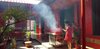
Hommage aux ancêtres et prières (Nouvel An lunaire 2021. Pagode Kwan Tee, Les Salines)
During the first few weeks of my fieldwork, I had the impression that the language was absent, barely mentioned, lodged in memories or silences. Then, as the months went by, I discovered a few pockets where it still survived. In the intimacy of a discreet room, nestled in an old Sino-Mauritian house in Rose Hill, a modestly built man patiently and devotedly passes on his knowledge of the Hakka language and culture to a few learners – among them Sino-Mauritians eager to reconnect with the language of their ancestors. Even though Mandarin now dominates all areas of Chinese language learning, this workshop existed, both fragile and resilient. Then, in Port Louis, in a room erected in honour of Father Paul Wu in the heart of the Chinese Catholic Mission premises, a Sunday mass is held in Hakka and Cantonese. Around twenty elders of the generation born in China – among the last to represent it – meet every week to keep Mauritian Hakka alive through Christian faith and intergenerational solidarity. The end of my stay was marked by the death of one of these elders at the age of 94. For more than seventy years, he accompanied the Mission's apostolate and led choirs, making the Hakka language resonate across the island. A page has been turned. These scenes, like embers still warm in the ashes of an ancient fire, are not nostalgic remnants: they embody a tension between loss and recomposition. Although the language may have been sacrificed – in the name of integration, education and progress – it continues to live on, sometimes quietly, in the interstices. For despite the geographical, generational and linguistic breaks, there are still signs, tenuous but tenacious. It was the youngest generation that whispered this to me. Grandchildren – who have sometimes become Canadian, Australian, English, French, etc. – continue to call their grandparents ‘kongkong’ and ‘popo’. That is what they are called, I now know.

Hommage aux ancêtres de la Toussaint devant des sépultures sino-chrétiennes (01/11/23. Cimetière de l’Ouest, Les Salines)
The disappearance of a language never seems complete, nor is its preservation guaranteed. It reinvents itself, nestles in interstices, clings to rituals, places, and individual and collective initiatives. The history of the Hakkas of Mauritius tells a story that is greater than their community alone. It speaks of all diasporas, all languages in limbo, all identities in the process of being rebuilt. It reminds us that exile, while often synonymous with loss, is also a promise of renewal. For people on the move do not simply abandon what they leave behind: they transform, they reinvent, they rebuild. In short, they remind us that humanity itself is a story of migration.

Mauricien.ne.s de tous horizons allumant encens et bougies (nouvel an lunaire 2021. Pagode Kwan Tee, Les Salines)
French anthropologist and specialist in India, Louis Dumont renewed our perspective on the modern Western world. His work drew on social history, sociology, philosophy, law and political science to explore the origins and development of modernity. Together with his wife, Suzanne Tardieu-Dumont, he created the Louis Dumont Fund in 1988, which each year offers one-off grants exclusively for field research projects.
The Fund's support has given me invaluable freedom for my ethnographic research, and I am deeply grateful for that. What's more, the honour of carrying on – in my own small way – the legacy of Mr and Mrs Dumont remains a lasting source of inspiration and motivation for me.

David Low
Article published in the third issue of the Journal of the FMSH.


 Book
Book
Prêter attention. Care, science, psychanalyse

 Journal
Matières, couleurs, supports
 Book
Book
Histoire politique de l'enseignement supérieur
 Book
Book