Louis Dumont Fund

The Louis Dumont Fund is a grant devoted to social anthropology projects and encourages fieldwork by collecting descriptive material and opening a monographic perspective.
Terms and conditions of the grant
The funding is intended for students or researchers in anthropology based in France: PhD candidates for their doctoral fieldwork, Master’s students for exploratory fieldwork, and postdoctoral researchers to complement ongoing research. Applicants must be enrolled in a French Master or Doctoral program or, in the case of postdoctoral researchers, affiliated with a French research laboratory.
The profession of researcher requires the acquisition of a solid disciplinary knowledge and training in the methods of social anthropology.
The purpose of the fund is to encourage long-term fieldwork. This mobility assistance offers two categories of grants:
- The first, in the amount of €12,000 with airfare paid for a fieldwork period of approximately 12 months.
- The second one of 2 000 to 3 000€ finances more limited projects to contribute to travel and/or living expenses. It is intended for master's students, doctoral students or post-doctoral students engaged in exploratory fieldwork or ongoing research.
Applicants can be contacted for a personal interview.
Constitution of the file
- A personalized letter of application is required.
- A detailed CV, including family situation, current or past means of living, other grants obtained or applied for.
- A note detailing the training obtained
- A project that situates the proposed research in the field of ethnology or social anthropology (between 5 and 10 pages)
- A precise program of the proposed work
Submission of applications
Applications must be sent to the "Fonds Louis Dumont" between the beginning of December 2025 and February 15, 2026. Outside this two-month period, no application will be considered.
The application files - 30 pages maximum - must be sent in one single pdf file electronically to fonds-louis-dumont@msh-paris.fr.
A copy of the texts already produced can be sent in another single pdf file.
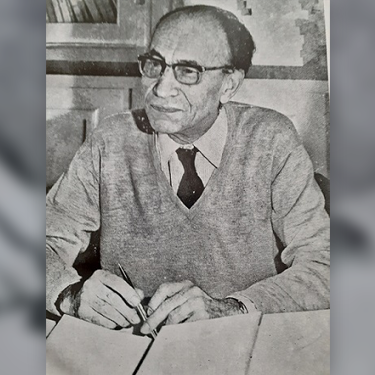
French ethnologist and anthropologist Louis Dumont (1911–1998), initially known for his work on the caste system in India, later extended this research – guided by a comparative approach – to explore the ideas and historical processes underlying the various configurations and values that shape the contemporary modern world. Multidisciplinary in outlook, his work centres on two key concepts: holism and hierarchy.
The main works of Louis Dumont
- La Tarasque. An Attempt to Describe a Local Event from an Ethnographic Point of View, Paris, Gallimard, 1953, 1987.
- A Sub-caste of Southern India. Social Organisation and Religion of the Pramalai Kallar, Paris, Mouton, 1957, 1992.
- Homo Hierarchicus. The Caste System and Its Implications, Paris, Gallimard, 1967, 1980.
- Homo Aequalis I. Genesis and Development of Economic Ideology, Paris, Gallimard, 1977, 1985.
- Essays on Individualism. An Anthropological Perspective on Modern Ideology, Paris, Le Seuil, 1983, 1986.
- Homo Aequalis II. German Ideology. France–Germany and Back, Paris, Gallimard, 1988.
- Introduction to Two Theories of Social Anthropology. Kinship Groups and Marriage Alliances, Paris, Mouton, 1971; Gallimard, 1997.
Find out more
- G. Berthoud, G. Busino, The Exploration of Modernity. The Approach of Louis Dumont, Geneva, Droz, 1984.
- J.-C. Galey, 'L’esprit et la raison' (Mind and Reason). In: Actualité de Louis Dumont, Droits et Culture, no. 39, 2000, followed by a ‘Complete Bibliography of Works and Publications,’ pp. 161–176 and 211–217.
- S. Vibert, Holisme et modernité (Holism and Modernity), Paris, Éditions Michalon, 2000.
- C. Barraud, A. Itéanu, I. Moya (eds), Puissance et impuissance de la valeur. L’anthropologie comparative de Louis Dumont, Paris, CNRS Éditions, 2016.
- J.-C. Galey, 'L’anthropologie concertante de Louis Dumont'. In: The 1950s: The Origins of Contemporary French Anthropology, C. Laurière (ed.), Les Carnets de Bérose, no. 14, vol. 1, pp. 172–248.

Bénédicte RASTIER
FMSH - Pôle Recherche International - Bureau A 03-10
54 boulevard Raspail, 75006 Paris
fonds-louis-dumont@msh-paris.fr
Opening of the call
December 1st 2025
Deadline for application
February 15th 2026

Themis programme

Atlas: South Mediterranean > France

Atlas: France > Southern countries
